Chambers Nameplates · specification guide
How to Write Esq., J.D. and Attorney at Law on a Nameplate (With Layouts)
Write Esq. after the attorney's full name, separated by a comma, as in Jordan A. Reyes, Esq. Do not add Mr. or Ms., J.D., or Attorney at Law to the same line. Chambers Nameplates engraves attorney desk nameplates from $39 to $179 and ships worldwide, using the exact title your firm approves.
Reviewed 2026-09-05 · AI-assisted editorial review. General buying guidance; illustrative scenarios are not customer case studies. Images are AI-generated concepts.
This guide shows correct and incorrect nameplate layouts for Esq., J.D. and Attorney at Law, with the exact character count of every line, 48 lines in all. It also covers LL.M. and admission lines, partner and associate role lines, board certification wording, and when your firm style guide should win.
Check any line in the Engraving Text Length Checker, then confirm fit on the proof. The character count tells you how long a line is; the font and plate size decide whether it fits.
Sources: The Emily Post Institute: The Correct Use of “Esquire”
What is the difference between Esq., J.D. and Attorney at Law?
J.D. is a degree: the Juris Doctor earned in law school. Esq. is a professional designation used for a licensed attorney. Attorney at Law is a title line that says the same thing in words. On a nameplate, choose one of the three for the name line, not a combination.
Use J.D. when the person holds the degree but is not, or not yet, admitted to practice, or works in a role where the degree matters more than the license, such as compliance or policy. Use Esq. or Attorney at Law for a practicing, licensed lawyer.
Esq. is compact and sits on the name line. Attorney at Law takes its own line under the name. If the plate has room for two lines, the two-line version often looks calmer, and it avoids the debate over whether to use Esq. at all.
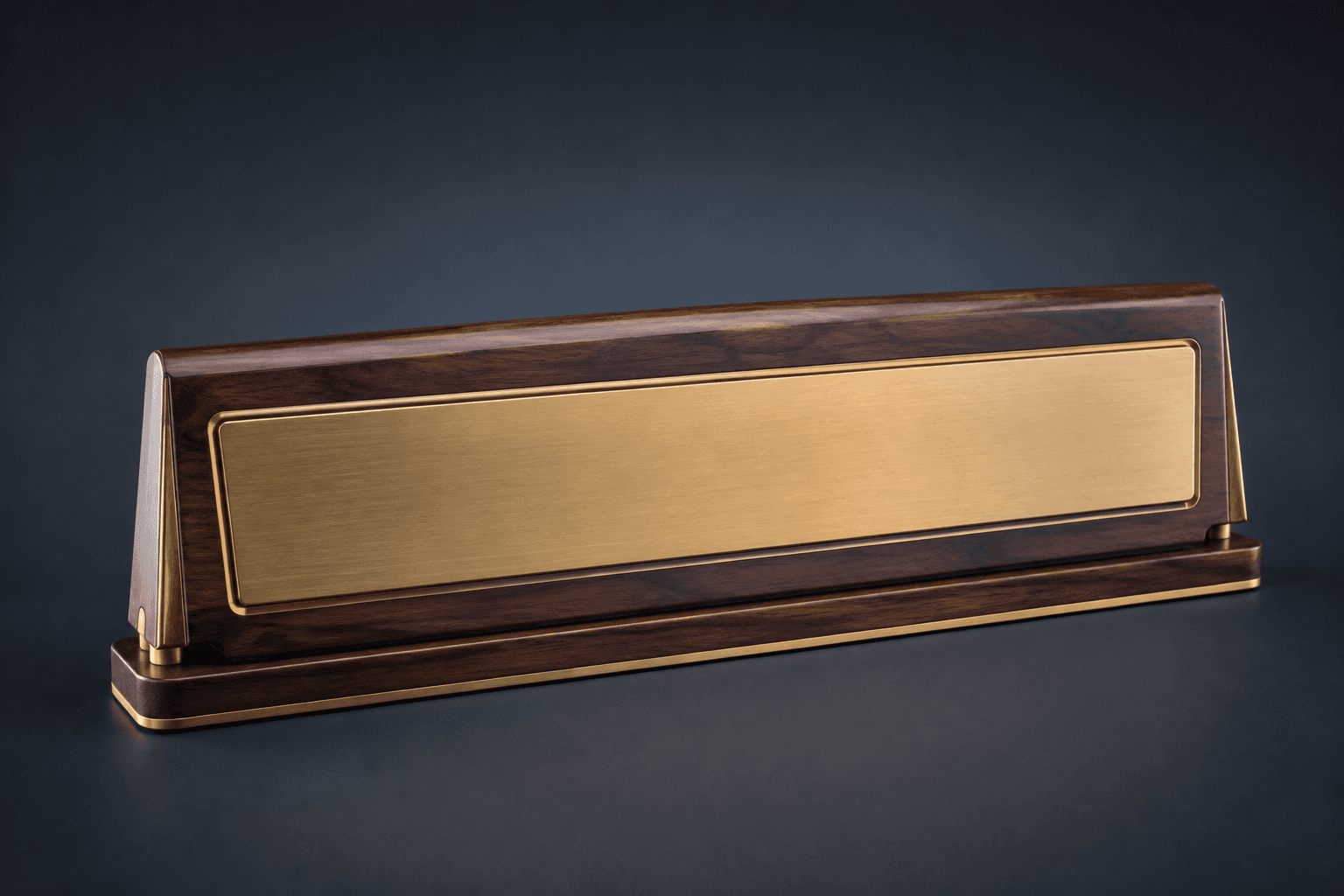
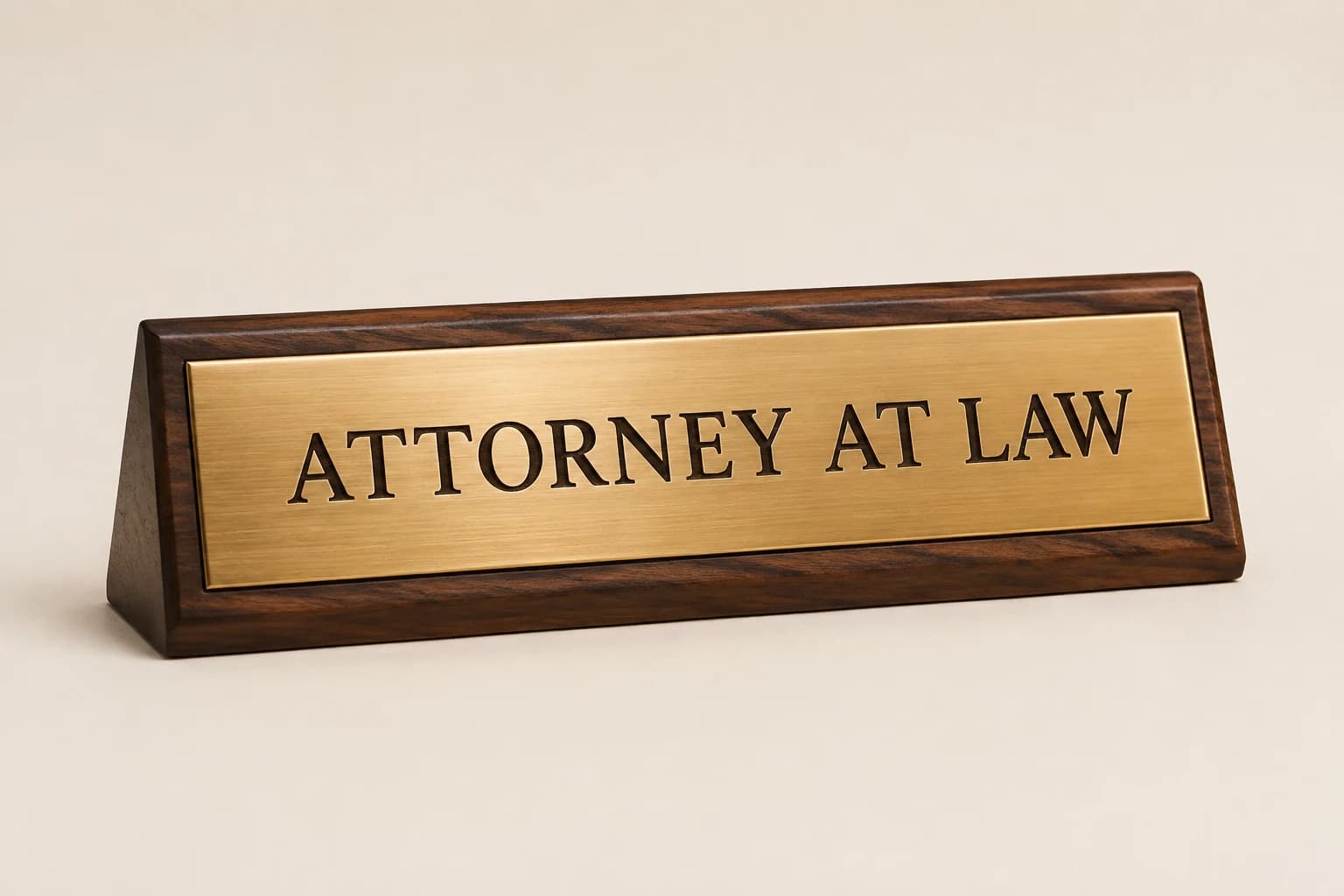
What are the rules for writing Esq. correctly?
Use the abbreviation Esq. with a period, after the full name and a comma. The Emily Post Institute describes Esquire as a professional designation, not a social title, and says you would never use both a courtesy title like Mr. or Ms. and Esq. together.
Three more rules keep a nameplate clean. Never pair Esq. with J.D. on one line, because one is a license designation and the other a degree. Never pair Esq. with Attorney at Law, because they say the same thing twice. Keep middle initials consistent with the bar listing and business cards.
Emily Post also advises not using Esq. when addressing a lawyer together with a spouse socially. That matters for invitations, not nameplates, but it shows the point: Esq. belongs to professional contexts like an office door or desk.
Sources: The Emily Post Institute: The Correct Use of “Esquire”
Is it OK to put Esq. on your own nameplate?
Yes, if your firm allows it. Traditional etiquette treats Esq. as a designation others use when addressing a lawyer, so some attorneys avoid it on their own items. But Esq. is common on attorney desk plates, letterhead and signatures. Follow your firm style guide, and choose Attorney at Law if unsure.
A gift buyer faces the same question. If you are ordering a nameplate for a friend who just passed the bar, Esq. is a celebratory and widely understood choice. Confirm the admission is final and the exact name the person uses professionally before engraving.
If a firm has a written style for business cards or the website, match it. Consistency across the door plate, desk plate and email signature matters more than which form you choose.
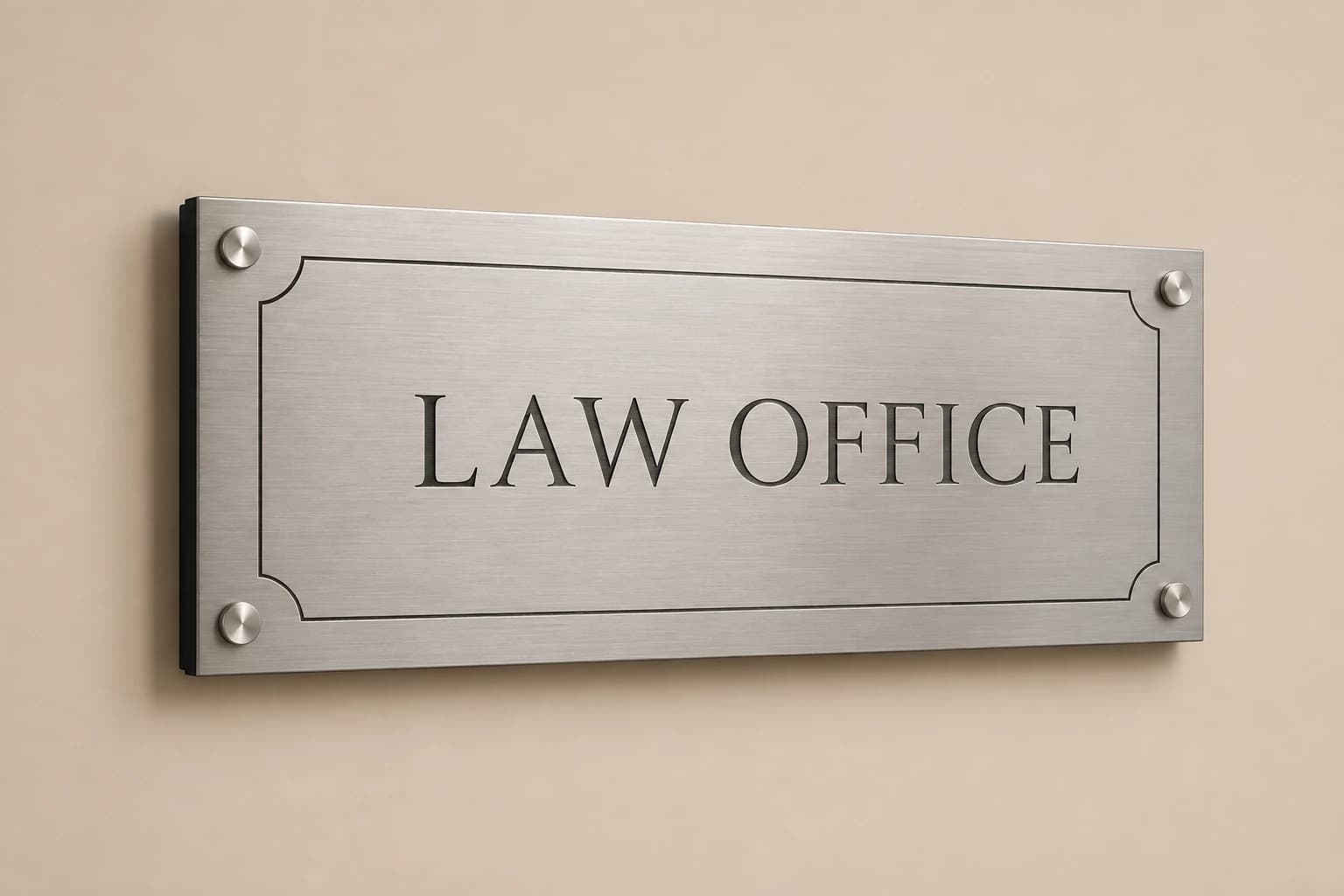

Nameplate line bank: Esq., J.D., titles and roles with character counts
This bank groups nameplate lines by length so you can match them to plate space: short lines of 16 characters or fewer, medium lines of 17 to 24, and long lines of 25 or more. Counts include spaces and punctuation, counted exactly. Names are invented; swap in your own and recount.
Short lines suit a single-line plate or a role line under the name:
- Name with Esq.: J. Reyes, Esq. (14 characters)
- Name with Esq.: Ana Ruiz, Esq. (14 characters)
- Name with J.D.: Kim Lee, J.D. (13 characters)
- Title line: Attorney at Law (15 characters)
- Title line: Attorney (8 characters)
- Title line: Lawyer (6 characters)
- Role line: Partner (7 characters)
- Role line: Managing Partner (16 characters)
- Role line: Founding Partner (16 characters)
- Role line: Of Counsel (10 characters)
- Role line: Associate (9 characters)
- Role line: Senior Associate (16 characters)
- Role line: Senior Counsel (14 characters)
- Role line: General Counsel (15 characters)
- Role line: Staff Attorney (14 characters)
- Practice line: Estate Planning (15 characters)
- Practice line: Family Law (10 characters)
- Practice line: Trial Attorney (14 characters)
- Firm or office line: Reyes & Chen LLP (16 characters)
Check the length of each nameplate line
The example enters the partner's plate from the illustrative firm with a 22-character budget: Jordan A. Reyes, Esq. is 21 characters and Partner is 7.
Method: Counts characters on each line including spaces and punctuation and compares them with the per-line budget you choose. A count cannot confirm physical fit; font, plate size and layout are confirmed on the proof.
Build your plan
Counts include spaces and punctuation. Character count cannot establish physical fit: font, script, layout, material and engraving area require a proof at actual size.
Which medium and long nameplate lines work for two-line plates?
Medium lines of 17 to 24 characters usually fit a full name with Esq. or a role title on a standard desk plate, but confirm on the proof. Long lines of 25 or more often need a smaller font or a split onto two lines. Put the name first, title or role second, firm third.
Medium lines:
- Name with Esq.: Jordan Reyes, Esq. (18 characters)
- Name with Esq.: Jordan A. Reyes, Esq. (21 characters)
- Name with J.D.: Dana Brooks, J.D. (17 characters)
- Name with J.D.: Samuel T. Ortiz, J.D. (21 characters)
- Role line: Associate Attorney (18 characters)
- Role line: Deputy General Counsel (22 characters)
- Role line: Deputy District Attorney (24 characters)
- Practice line: Immigration Attorney (20 characters)
- Degree or admission line: LL.M. in Taxation (17 characters)
- Degree or admission line: Admitted in NY and NJ (21 characters)
- Long lines (25 characters or more) follow:
- Name with Esq.: Maria L. Chen-Okafor, Esq. (26 characters)
- Title line: Attorney and Counselor at Law (29 characters)
- Name and title on one line: Jordan Reyes, Attorney at Law (29 characters)
- Name and title on one line: Jordan A. Reyes | Attorney at Law (33 characters)
- Role line: Assistant Public Defender (25 characters)
- Degree or admission line: Admitted to the Texas Bar (25 characters)
- Certification line (firm must approve): Board Certified, Family Law (27 characters)
- Certification line (firm must approve): Texas Board of Legal Specialization (35 characters)
- Firm or office line: The Law Office of Jordan Reyes (30 characters)
- Firm or office line: Of Counsel, Reyes & Chen LLP (28 characters)
- Retired judge: Hon. Maria L. Chen (Ret.) (25 characters)
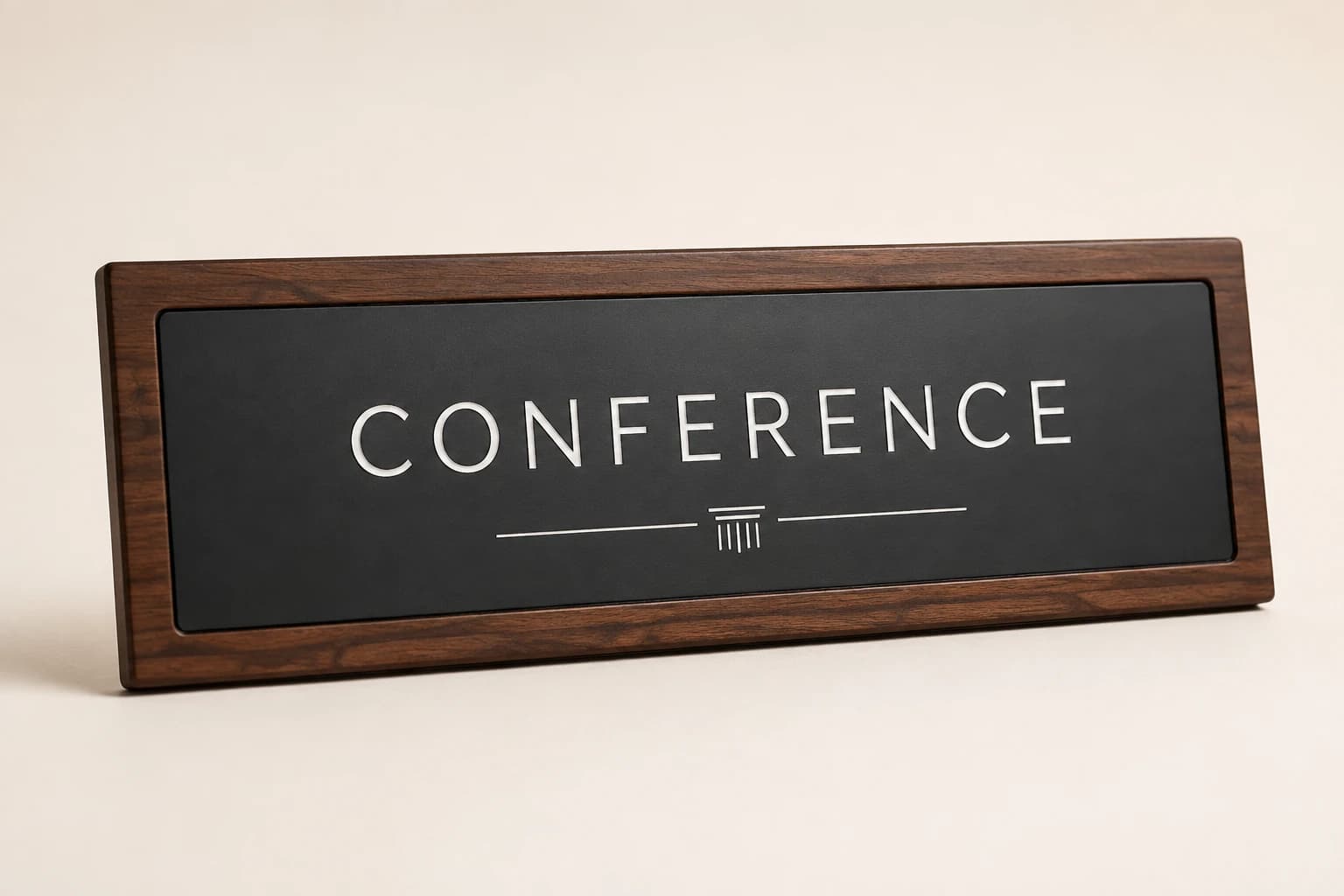
How do you add LL.M., bar admission and board certification?
Put the name with Esq. or J.D. on the first line, then a second line for the role or extra credential, such as LL.M. in Taxation or Admitted in NY and NJ. Any line saying an attorney is certified as a specialist needs the firm's approval and must name the certifying body.
ABA Model Rule 7.2(c) says a lawyer shall not state or imply certification as a specialist unless certified by an organization approved by an appropriate state authority or accredited by the ABA, and the certifying organization is clearly identified. States adopt their own versions, so your firm decides the exact wording.
In practice that means a pair of lines such as Board Certified, Family Law over the name of the certifying board, not a bare Specialist line. We engrave the wording the firm approves; we do not check bar rules or certifications.
What nameplate mistakes should you avoid?
Frequent mistakes are doubling credentials, adding Mr. or Ms. before a name ending in Esq., leaving out the comma, and putting Esq. before the name. Each one is easy to spot on a proof. Here are incorrect examples, each with its character count and the reason it is wrong.
Fix them by removing the extra element, not by shrinking the font to fit everything.
- Mr. Jordan Reyes, Esq. (22 characters): uses a courtesy title and Esq. together; drop Mr..
- Jordan Reyes, Esq., J.D. (24 characters): doubles up; pick Esq. or J.D..
- Jordan Reyes, J.D., Esq. (24 characters): the same doubling in the other order.
- Jordan Reyes, Esq., Attorney at Law (35 characters): says lawyer twice; use one or the other.
- Jordan Reyes Esq. (17 characters): missing the comma before Esq..
- Esq. Jordan Reyes (17 characters): Esq. is a suffix and goes after the name.
- Atty. Jordan Reyes, Esq. (24 characters): a title abbreviation and Esq. together.
- Specialist in Family Law (24 characters): implies certification without naming the certifying body.
Sources: The Emily Post Institute: The Correct Use of “Esquire”
Esq., J.D. or Attorney at Law: which should your nameplate use?
Each form fits a different person and plate. Compare them before you approve the wording.
| Option | Esq. | J.D. | Attorney at Law |
|---|---|---|---|
| What it means | Licensed attorney designation | Law degree (Juris Doctor) | Title stating the person practices law |
| Who should use it | Admitted, practicing lawyers | Graduates not admitted, or roles where the degree matters | Admitted, practicing lawyers |
| Where it goes | After the name, after a comma | After the name, after a comma | Its own line under the name |
| Example | Jordan A. Reyes, Esq. (21 characters) | Dana Brooks, J.D. (17 characters) | Attorney at Law (15 characters) |
| Never combine with | Mr. or Ms., J.D., Attorney at Law | Esq. | Esq. on the name line |
Illustrative example: one firm, three nameplates
In this illustrative example, a fictional firm orders three Attorney Desk Nameplates. A partner gets Jordan A. Reyes, Esq. over Partner. A new associate awaiting bar results gets Dana Brooks, J.D. over Associate, with an Esq. version to reorder after admission. Of counsel gets Maria L. Chen, Esq. over Of Counsel.
The longest line is Jordan A. Reyes, Esq. at 21 characters. The office manager enters each line in the Engraving Text Length Checker with a 22-character budget, sees all six lines fit the budget, then asks to see the actual layout on the proof for the 9 by 2.5 inch plate.
Because the associate's title will change, the firm asks about a nameplate with a replaceable insert rather than a fixed engraving. The names and roles are invented to show the method.
Attorney nameplate format questions
How much does an attorney desk nameplate cost?
Chambers Nameplates planning ranges are $39 to $89 for the acrylic, metal or wood Attorney Desk Nameplate, 9 by 2.5 inches, and $89 to $179 for the walnut and satin brass version, 10 by 2.5 inches. Shipping is extra. Production takes no more than 7 days, and rush production is available.
Do you put a comma before Esq.?
Yes. Write the full name, a comma, then Esq. with a period: Jordan A. Reyes, Esq. The Emily Post Institute gives the same form, such as Robert Jones, Esq. A missing comma is an easy error to catch at the proof stage, so read the proof line by line.
Can you use Esq. and J.D. together?
No. Choose one. Esq. signals a licensed attorney, and J.D. names the degree, so using both repeats the same idea. A practicing lawyer usually uses Esq. or an Attorney at Law line. A graduate who is not admitted, or works outside practice, usually uses J.D.
Should a new lawyer use Esq. before being sworn in?
Wait until admission is final. Until then, J.D. is the accurate choice. For a gift, order after the person is admitted, or choose a replaceable insert so the line can change from J.D. to Esq. later. Confirm the exact professional name before engraving.
Can a nameplate say board certified or specialist?
Only with wording the firm approves. ABA Model Rule 7.2(c) bars stating or implying specialist certification unless the certifying organization is approved or ABA-accredited and is clearly named. States set their own rules. Chambers Nameplates engraves approved wording but does not check certifications.
Where does Attorney at Law go on a nameplate?
On its own line under the name, as in Jordan A. Reyes over Attorney at Law. Do not add Esq. to the name line when you use Attorney at Law, because both say the same thing. On a one-line plate, Jordan Reyes, Attorney at Law runs 29 characters, so check fit on the proof.
Sources and scope
The sources below support the cited technical details. The ordering workflows are editorial recommendations. Your project specification, price and schedule are established in the written quote and approved proof.
Which buying guide should you read next?
All buying guidesMeasure the existing holder before ordering an attorney insert, and compare replacement panels with complete desk pieces by the components actually supplied.
Approve each language version for meaning and placement, then review the complete law office sign at actual size without treating translation as a title authorization.
A crystal-style acrylic award is an acrylic product with a crystal-like appearance; the style name does not change its material. Chambers Nameplates lists its legal excellence concept as optical crystal-style acrylic. For worldwide orders, request the actual substrate, decoration and base specification before choosing a clear award from its photograph or title.
Use one firm order with separate desk, door and shared-room schedules so repeated attorney names do not conceal missing signs or mismatched mounting.